
BarclayHedge has been a fixture in the hedge fund data world since 1985. Few databases can match its depth of performance analytics, and its indices are cited in financial journals around the globe. But depth and longevity are not the only things that matter when choosing a hedge fund database. Depending on what you actually need the data for, BarclayHedge might be exactly right, or it might be $5,000 a year more than necessary.
This guide walks through how BarclayHedge compares with four alternatives: Preqin, PitchBook, HFR, and HedgeLists. We look at what each one does best, what it costs, and who should be using it.
What Is BarclayHedge?
BarclayHedge, now a division of Backstop Solutions under the ION Analytics umbrella, is one of the most established names in hedge fund data. The company started publishing fund data for CTAs and hedge funds in 1989 and currently tracks more than 6,000 active funds and 26,000+ total alternative investment vehicles (including graveyard funds that have liquidated or stopped reporting).
What sets BarclayHedge apart from broader platforms like Preqin or PitchBook is its laser focus on the hedge fund and managed futures universe. Every fund profile includes 350+ data fields covering performance history, fee structures, redemption terms, investment minimums, risk metrics, and strategy classifications. The platform is updated daily, and its indices (31 hedge fund, 10 CTA, and 7 UCITS) are widely used as performance benchmarks.
BarclayHedge Key Features
- 6,000+ active hedge funds with 350+ data fields each
- Graveyard database of 27,000+ liquidated or non-reporting funds
- Daily performance data refresh
- 31 hedge fund indices, 10 CTA indices, 7 UCITS indices
- FundFinder Pro search and analysis tool
- Contact marketing database (Enhanced tier) with emails, phone numbers, and bios
- SEC equity holdings data for registered hedge fund managers
- Cryptocurrency fund database
BarclayHedge Pricing
BarclayHedge is one of the few hedge fund databases that publishes pricing:
- Pro: $5,000/year. Includes premium search, daily performance data, comprehensive fund fact sheets, SEC equity holdings, and contact details for up to two principals per fund.
- Enhanced: $7,250/year. Adds expanded contact information, contact details for non-reporting funds, and dedicated contact marketing tabs for building outreach lists.
Both tiers are annual subscriptions.
Why Look for BarclayHedge Alternatives?
BarclayHedge is a genuinely strong product. But “strong” does not always mean “right for you.” Here are the most common reasons people shop around:
- You don’t need performance data. BarclayHedge’s 350+ data fields are extraordinary if you are analyzing fund returns, comparing fee structures, or building a portfolio. If you just need contact data to fill a CRM, most of those 350 fields are irrelevant, and you are paying for analytical depth you will never open.
- The contact data costs extra. Detailed marketing contacts (emails, bios, titles beyond the basics) require the Enhanced tier at $7,250/year. That is reasonable for a firm doing ongoing outreach at scale, but steep for a one-time prospecting project or a job search.
- Annual subscriptions add up. Even the Pro tier at $5,000/year means $25,000 over five years. Users who need hedge fund data periodically, not daily, may prefer a one-time purchase model.
- No investor or LP data. If you need to know who is allocating to hedge funds (pension funds, endowments, family offices), BarclayHedge does not cover that. You would then need Preqin or PitchBook.
- No cross-asset coverage. BarclayHedge is hedge funds and CTAs only. Teams that also work in private equity, venture capital, or real estate might need a broader platform.
BarclayHedge vs. the Competition
The comparison below covers the five most relevant options for hedge fund data. Same industry, very different tools.
| Feature | BarclayHedge | Preqin | PitchBook | HFR | HedgeLists |
|---|---|---|---|---|---|
| Pricing Model | Annual subscription | Annual subscription | Annual per-seat license | Annual subscription | One-time purchase |
| Estimated Cost | Contact for pricing | ||||
| Active Funds Tracked | 6,000+ | 30,000+ | Broad (not HF-specific) | 7,500+ | 10,000+ |
| Performance Data | ✓ 350+ fields, daily refresh | ✓ Comprehensive | ✓ Fund returns & benchmarks | ✓ 500+ indices | ✗ Not included |
| Contact / Email Data | ● Enhanced tier only ($7,250) | ✓ Included | ✓ Included | ✗ Minimal | ✓ Up to 6 emails per fund |
| Graveyard / Dead Funds | ✓ 27,000+ funds | ✓ Included | ● Limited | ✓ 23,000+ funds | ✗ Active funds only |
| Industry Indices | ✓ 48 indices | ● Limited | ✗ Not a focus | ✓ 500+ indices (gold standard) | ✗ Not included |
| Investor / LP Data | ✗ Not included | ✓ Extensive | ✓ Extensive | ✗ Not included | ✗ Not included |
| Data Format | Excel, Access, online | Online platform (limited export) | Online platform (export limits) | Online platform | Excel & CSV download |
| Purchase Process | Online or demo | Sales call required | Sales call required | Sales call required | Instant online checkout |
| Best For | Performance analytics & fund selection | Multi-asset institutional DD | PE/VC deals & capital markets | Index benchmarking & research | Contact data for outreach & prospecting |
Four Alternatives to BarclayHedge
r1. Preqin
Best for: Institutional allocators and consultants who need visibility across every alternative asset class
Pricing: ~$15,000–$50,000+/year
Website: preqin.com
If BarclayHedge is a specialist, then Preqin is the generalist’s generalist. It covers hedge funds alongside private equity, venture capital, real estate, infrastructure, natural resources, and private debt. BlackRock acquired the company for $3.2 billion in early 2025, which tells you something about how the institutional world values its data. Preqin’s real differentiator is its investor database: detailed profiles of pension funds, endowments, family offices, and sovereign wealth funds with allocation mandates, commitment histories, and contact details.
Why choose Preqin over BarclayHedge: You need investor/LP data alongside fund data. You work across multiple alternative asset classes. You want fundraising intelligence and mandate tracking.
Why stick with BarclayHedge: You only realy care about hedge fund performance. You want 350+ data fields per fund. You need recognized industry indices. You want to spend $5,000 instead of $15,000+.
2. PitchBook
Best for: Investment banks, PE/VC firms, and corporate development teams
Pricing: ~$20,000–$50,000+/year
Website: pitchbook.com (a Morningstar company)
PitchBook is the Swiss Army knife of financial data. It covers deals, companies, funds, investors, and service providers across virtually every corner of the capital markets. The platform is backed by 2,000+ researchers and has become the default tool for anyone doing PE/VC deal sourcing. Hedge fund data is available but is not the star of the show.
Why choose PitchBook over BarclayHedge: You need deal-level transaction data. You work across PE, VC, and hedge funds. You want CRM integration and API access. Your firm already has PitchBook licenses for other workflows.
Why stick with BarclayHedge: PitchBook’s hedge fund performance data is not as granular (350+ fields vs. PitchBook’s more general profiles). BarclayHedge costs a fraction of the price. If hedge fund analytics is your primary use case, BarclayHedge delivers more for less.
3. HFR (Hedge Fund Research)
Best for: Institutional investors and academics who live and breathe hedge fund benchmarking
Pricing: Not published
Website: hfr.com
HFR and BarclayHedge are the two heavyweights in hedge fund performance data, and choosing between them is a legitimate debate. HFR’s HFRI Index family (500+ indices) is arguably the most widely cited hedge fund benchmark in the world. The indices are IOSCO-compliant and ESMA BMR-certified, which matters if you are a regulated institution. HFR tracks 7,500+ funds and has over 30 years of data history.
Why choose HFR over BarclayHedge: You need the HFRI indices specifically (many institutional mandates reference them). You want the broadest index coverage available. Your compliance team requires IOSCO/ESMA-certified benchmarks.
Why stick with BarclayHedge: BarclayHedge publishes pricing openly ($5,000/$7,250). It offers a contact marketing database that HFR does not. Its graveyard database (27,000+ funds) is slightly larger. And if you need CTA/managed futures data specifically, BarclayHedge has been tracking that space since 1989.
4. HedgeLists
Best for: Sales teams, marketers, recruiters, job seekers, and researchers who need contacts, not analytics
Pricing: $117–$237 one-time (12 months of updates included)
Website: hedgelists.com
Here is the thing about BarclayHedge: it is a phenomenal tool for analyzing hedge fund performance. But if you are a fintech sales rep who needs 500 hedge fund email addresses by Friday, 350 data fields of return history are not going to help you hit quota.
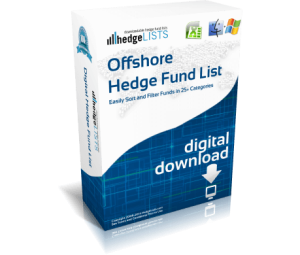
That is where Hedge Lists fits. It strips away the analytics and gives you what outreach-focused professionals actually use: names, titles, direct emails, phone numbers, company details, AUM, strategy, and hiring status. The data covers 10,000+ funds across 30+ countries, organized into targeted lists by strategy (Long/Short, Global Macro, Credit, Commodities, Energy, Real Estate, and more) and by geography (individual countries and regions).
A few things that make HedgeLists a particularly interesting BarclayHedge alternative:
- The price gap is enormous. A HedgeLists purchase costs $117 to $237 once. BarclayHedge’s Enhanced tier with contact data runs $7,250 per year, every year. Over three years, that is a difference of roughly $21,500.
- You get the data in minutes. No subscription setup, no account provisioning, no training sessions. Buy, download, open in Excel. Done.
- The data is portable. Excel and CSV files that work in any CRM, any spreadsheet, any mail merge tool. No platform dependency.
- One purchase covers the team. No per-seat fees. Your marketing coordinator, your sales lead, and your MD can all work from the same file.
What you give up: Performance return data, risk analytics, fee structure details, industry indices, and the graveyard database. If you need those things, BarclayHedge is worth the investment. If you need contacts, HedgeLists gets you there faster and cheaper.
So Which One Should You Actually Buy?
It really depends on one question: what are you going to do with the data?
If the answer involves analyzing returns, building risk models, or benchmarking manager performance, you want a platform with deep performance data. BarclayHedge and HFR were built for this. BarclayHedge is the better choice if you also want contact details and transparent pricing. HFR wins if index-level benchmarking is your primary workflow.
If the answer involves sending emails, making calls, or importing contacts into a CRM, you want clean contact data in a file you own. HedgeLists was built for this, and nothing else on the market matches its combination of coverage, price, and simplicity.
If the answer is “all of the above, plus I need LP data, deal flow, and PE/VC coverage,” then you are mostly looking at Preqin or PitchBook. They cost 3x to 10x more than BarclayHedge, but you are also getting 3x to 10x more platform.
There is no single “best” hedge fund database. There is only the one that matches your use case and your budget. The good news: at this point you know enough about each option to make that call with confidence.
Skip the Subscription. Get the Contacts.
HedgeLists databases cover 10,000+ hedge funds with direct emails, executive names, AUM, strategy, and 37 more data fields per fund. One-time purchase from $117, delivered instantly in Excel and CSV. No annual commitment, no sales call, no surprises.
A Few More Names Worth Mentioning
The hedge fund data world extends beyond the big five. A couple of other options that surface in conversations about BarclayHedge alternatives:
- Eurekahedge / With Intelligence: Eurekahedge merged into With Intelligence in recent years, combining hedge fund data with HFM’s editorial coverage to create a platform that blends analytics with industry journalism. It offers fund profiles, investor data, indices, and a CRM tool for asset managers. Pricing is not published. If you value editorial context alongside raw data, it is worth a look.
- HedgeCo.Net: The internet’s largest free hedge fund directory. Good for quick lookups and reading industry news. Not a serious replacement for BarclayHedge’s analytical depth or HedgeLists’ contact data, but useful as a free supplement.
- Bloomberg Terminal: If your desk already has a Bloomberg (~$24,000/year), you can access some hedge fund data without a separate subscription. The coverage is not as specialized as BarclayHedge, but it may be “good enough” for firms that only need occasional hedge fund lookups.
Frequently Asked Questions
BarclayHedge offers two main tiers. The Pro subscription is $5,000/year and includes premium search, daily performance data, fund fact sheets, and basic contact info (up to two principals per fund). The Enhanced subscription is $7,250/year and adds expanded contact marketing data with emails, phone numbers, bios, and contact tabs for non-reporting funds. Both are annual subscriptions.
The Pro tier includes basic contact details for up to two principals per reporting fund. For expanded contact data, including emails, phone numbers, and bios for a broader set of contacts (including non-reporting funds), you need the Enhanced tier at $7,250/year. If contact data is your primary need, HedgeLists offers up to 6 emails per fund starting at $117 as a one-time purchase.
It depends on the use case. For pure hedge fund performance analytics, BarclayHedge offers deeper fund-level data (350+ fields) at a significantly lower price point than Preqin or PitchBook. However, BarclayHedge does not include investor/LP data, deal-level transactions, or cross-asset coverage. If you need those capabilities, Preqin or PitchBook are better suited despite their higher cost.
Both specialize in hedge fund performance data and indices. HFR’s HFRI indices (500+) are the most widely cited hedge fund benchmarks globally and carry IOSCO/ESMA certification, making them the standard for regulated institutions. BarclayHedge offers more data fields per fund (350+), a larger graveyard database, and a dedicated contact marketing product. BarclayHedge also publishes transparent pricing, while HFR requires a sales conversation.
Yes. HedgeLists provides downloadable databases of 10,000+ hedge fund contacts in Excel and CSV format. Lists are organized by strategy and geography, with each fund including up to 6 email addresses, executive names, AUM, and 40 total data categories. Prices range from $117 to $237 as a one-time purchase with 12 months of free updates. No subscription required.
BarclayHedge was acquired by Backstop Solutions in December 2018. Backstop is part of ION Analytics, a division of ION Group. The BarclayHedge brand and databases continue to operate under the ION Analytics umbrella. The product and data remain available, though the company is no longer independent.